Articles
Feeling Hot, Hot, Hot
08.20.2021
Last year, ABC viewers were treated with a welcomed distraction from all the news surrounding the upcoming election and pandemic. The tightrope artist of the famed Flying Wallendas, Nik Wallenda, decided to walk across the Masaya Volcano, or “The Mouth of Hell,” 2,083 feet high in Nicaragua. We highlighted Nik and his act in a prior Market Monitor but didn’t think he would follow through with his promise to walk across an active volcano. However, the feat that he accomplished was nothing short of extraordinary. The walk itself was 1800 ft. While Nik took some flak online for safety equipment, it was an outstanding feat of athletic ability that few in any other people on that planet could accomplish (because we aren’t crazy!!).

I was reminded of the hot walk when the Bureau of Labor Statistics released the latest numbers for the Jobs Openings and Labor Turnover Survey or commonly referred to as the JOLTS survey. The survey shows how many job openings are available each month, how many people got hired, how many voluntarily quit jobs, how many were laid off, and finally, how many experienced other work separations. This survey, along with the unemployment numbers, is regularly used by economists and central bank policymakers to assess the underlying strength in the labor market. For example, when many people are willing to leave their jobs voluntarily, that is a sign of strength, as they are confident enough in the number of jobs available to get a different position. In addition, they may be enticed by higher pay, better benefits, or a potential career change, and that usually is only the case when there are lots of employers hiring.
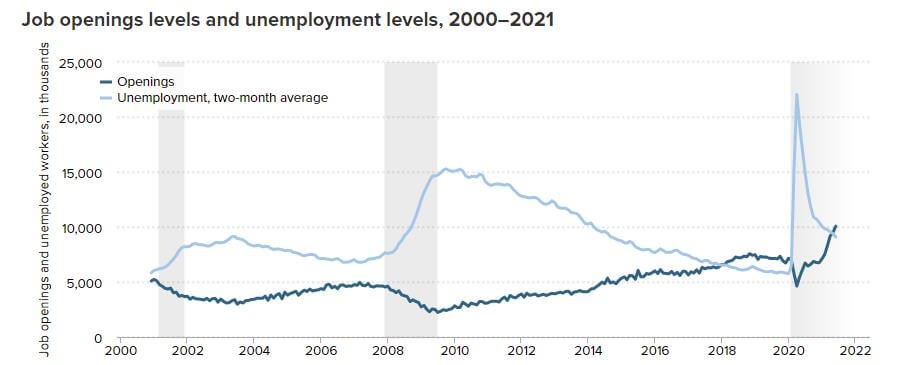
As an anecdote to the strength of our local labor market, I have noticed almost every business has signs that they are hiring, and it isn’t just exclusively the service industry that I’m seeing the need for new employees. After suffering greatly in 2020 during the height of the economic shutdowns, the labor market is storming back to life as consumer confidence returns. And this fact is born out in the chart below. Job openings are now greater than the overall number of unemployed, which we have rarely seen in the last 20 years.
While the past isn’t the present, we can look back at the Federal Reserve policy actions in the 1970s as a similar period. The then-Fed Chairman, Paul Volker, raised interest from 11.2% in 1979 to 20% by June of 1981. Inflation during that time reached a high of 13.5% and subsequently dropped to 3.2% by 1983.
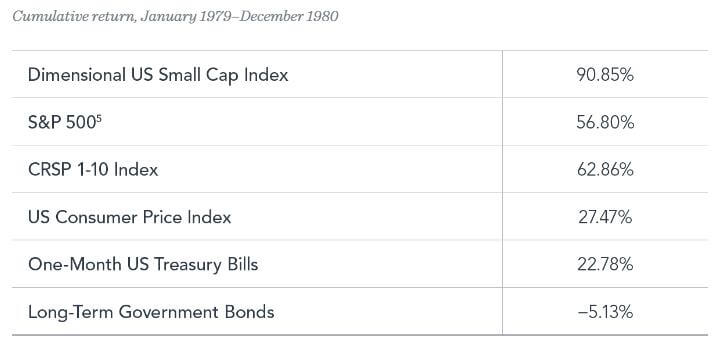
Given all the turmoil during that time, it might surprise many when we look at how indices performed.
The Federal Reserve has indicated that interest rates will remain low for the following years, but that might change if we continue to see data pointing to hotter than expected conditions in the economy.
So investors that may be nervous about the prospect of a bond market impact should take note that even during a period like the late 1970s, long-term bonds were down. Still, RK has structured our bond portfolios to exclude the longer-dated bonds at the most risk of losses should interest rates suddenly rise. While it may seem “Hot, Hot, Hot” in the markets right now, it’s not something that we can either control or predict. Focus on what you can control in your financial life.
Nathan Smith is a Portfolio Manager with Rather & Kittrell.