Articles
Keeping perspective (about rates)
09.23.2022
I’ve got some thoughts to share.
Higher-than-expected inflation data slammed investor expectations and rippled through markets, causing a broad selloff.¹
Why are markets selling off?
Folks were hoping that tamer inflation would cause the Federal Reserve to pull back on its interest rate hikes.
Unfortunately, the hot inflation data means the Fed is likely to continue aggressive rate hikes in the months to come, spooking investors who expected a pivot away from higher rates.
When the Fed sets higher interest rates, it increases the cost of credit across the entire economy, making mortgages, car loans, credit cards, business financing, etc. more expensive.
Investors worry that those higher rates will slow the economy (and maybe tip it into recession) and ding company performance.
Higher interest rates could also make investors less willing to accept steep valuations amid risks to future earnings growth.
What could be the longer-term impact of rate hikes?
Whenever we want to understand what could happen, it’s useful to go back in time and take a look at what’s happened before. While the past can’t predict the future, it’s often a useful guide.
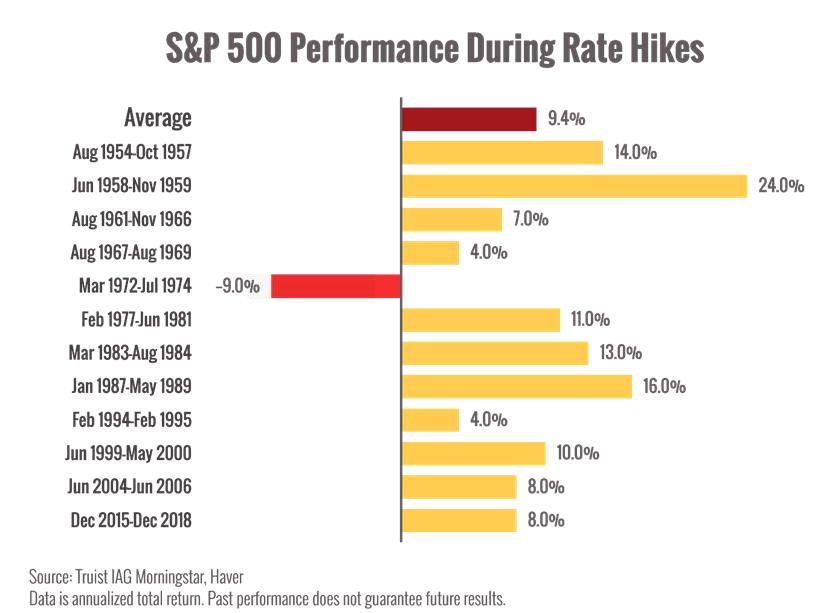
An analysis of 12 previous rate hike cycles shows that, overall, equity markets handled tightening reasonably well. Across these cycles, the S&P 500 averaged a total return (including interest, dividends, etc.) of 9.4%.²
So, what can history teach us?
Stocks tended to take rate hikes in stride over time.
However, those historical gains didn’t come in a straight line. They included dips, shocks, selloffs, and bear markets. They even included a few recessions.
Folks who bailed on the ride down probably missed a lot of the ride back up.
Predictions are a murky business. While what happened in the past is useful to a point, it’s not a map of the future.
What’s the bottom line?
I think more volatility on the upside and downside is in the cards for the days and weeks ahead. As investors digest the Fed decision, economic data, and Q3 corporate earnings, we’re going to see some reactions, positive and negative.
However, I don’t think it’ll all be gloom and doom. I think markets are forgetting that there’s a lot of uncertainty and margin for error in economic data.
Bottom line, we’re keeping an eye on markets and the economy, and we’ll reach out with more insights as we have them.
If you have any questions, please reach out.
We are here to help.
Chris Kittrell is a Principal with Rather & Kittrell.