Articles
How Focusing on What You Can Control Can Improve Your Financial Strategy
01.26.2024
Almost a foot of snow fell in Knoxville on Monday, January 15th. Also, on Monday, I was flying home with my husband and another couple from our dear friend’s destination wedding.
As you may have guessed, we did not make it home on Monday. Instead, our flight was canceled, and there were no flights home until Wednesday.

We were faced with two options.
Option #1: wallow in the inconvenience of two more nights away from home/work, additional hotel expenses, and missing a rare Knoxville snow.
Option #2: appreciate the fact that the city we were stuck in happened to be sunny Miami and make the most of it.
We chose option #2.
Throughout this experience, my earliest traveling memory was in the back of my mind.
I remember a stranger screaming at an airport employee. I remember my dad calmly explaining to me that something went wrong with our travel plans, that we were going to get a snack and find a new flight, and that’s all we could control. He explained that this is a part of traveling – inconveniences will happen and you have to roll with them. It intrigues me that his calm demeanor and explanation made a lasting impression on me at a young age.
It’s clear that this lesson helps when stuck in Miami, but it applies to so much more than travel.
What areas of your life would be impacted the most by focusing on what you can control, and letting go of what you cannot?
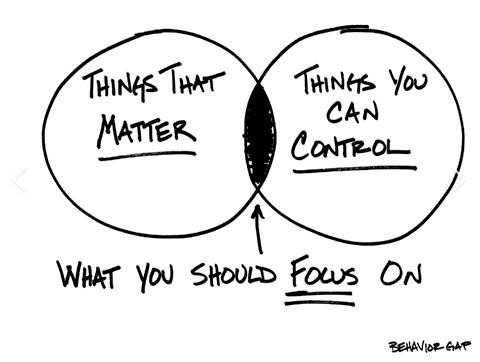
Now, a note for my fellow type-A individuals. Letting go is not in my nature. It feels passive, and I am inclined to favor action. Not only that, but I have seen the benefit of taking action and planning for “if this, then that” scenarios while others sit still claiming that nothing could be done. So, when I speak to focusing on what you can control, I do so with an understanding that quite a lot is in fact in our control.
For example, with this Miami travel scenario, there were “if this, then that” plans made. We saw the snow forecasts and looked into flying home early, alternate routes, and hotel and restaurant options if we got stuck in Miami. All this planning allowed me to relax and make the most of the travel day as the stuck-in-Miami scenario played out. I knew we had weighed our options, and we had a plan for what we could control. And only then did I confidently let go of what I couldn’t control.
Now for an investing example. We do not know what the markets will do in the coming year. However, we do know our clients’ risk tolerance, risk capacity, and the financial science behind disciplined and unemotional portfolio management. While there is so much in the world that we cannot control, we are not throwing up our hands exclaiming ineptitude. Instead, we have played out the “if this, then that” scenarios based on all we do know. We have a plan, and we take action or hold steady accordingly.
I also think of the intense but real example of being unable to control our mortality.
It’s the ultimate example of something that is out of our control and something that would be nice to never think about. But there is so much we can do regarding insurance, estate, and legacy planning to prepare, lessen the burden on our loved ones, and leave a legacy we will be proud of.
David Foster Wallace said, “Everything I’ve ever let go of has claw marks on it”.
I believe that holding both the lesson of “focus on what you can control” and the passion of “what I care about and let go of will be left with claw marks” would make for an incredible life.
We’re here to help you strike this balance in your financial lives. And next time your travel plans go awry, I hope you choose to focus on what you can control and “get a snack and roll with it”.
Hannah Whatley, CFP®, AIF® is an Advisor with Rather & Kittrell.