Articles
Left Gun, Right Square
11.05.2021
If you are scratching your head wondering what in the world I’m talking about, you, without a doubt, have played or watched this game a few times and have heard that hypnotic music. If you are around my age, you probably remember pestering your parents to give you back the Gameboy so you could have a turn, or like my wife remembers, hearing your parents playing with your present the night before Christmas. If this is jogging your memory now, the game that I’m talking about is the classic game of Tetris.
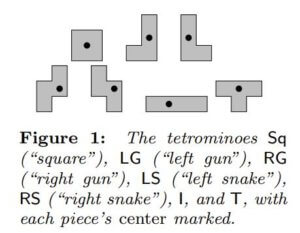
Tetris is a straightforward game matching the above pieces into lines that stretch across the screen and accumulate as many lines and points as you can before you run out of space. The most lines you can clear at one time is four, which is called a Tetris. The pieces can be rotated as they fall to fit together like a puzzle. As you clear more lines, the pieces fall faster and faster, assuring that eventually, you will run out of space, ending that game.
In terms of strategy, there are a few different ways to go about it, and without boring you with too much information, I will briefly cover two of them. The first strategy is how I play (the right way!), and the second is how my wife plays. My approach is to build towering blocks and only clear lines when I have a Tetris. Often, I go out of my way to make extra moves, even when I can clear one or two lines at a time. But, to me, I get enjoyment playing at a frenetic pace, and while I strike out often, I savor the times when everything works out perfectly.
On the other hand, my wife takes the strategy of playing it safe and getting easy wins. The times she gets a Tetris is early on in the game when the pieces are moving slowly, and the consequence for making mistakes is minimal. She enjoys keeping the towers of blocks as close to the bottom as possible.

Both of us nitpick each other’s playing habits, and I generally keep my comments to myself, but she can’t help but to audibly gasp or groan when she watches me play. It stresses her out to see me take what she considers avoidable risks. My daughter has even gotten into the act of telling me how to play. Likewise, when I watch her play, I’m amazed that she doesn’t just go for it, especially when I don’t think the risk is that great. It makes me want to pull my hair out because she could have a much better score if she took more risks.
This type of behavior in playing games often translates well into how we view our tolerance for risk when investing, and it is no different for us. However, investing is most certainly not a game, and playing too aggressively or too conservatively can cause investors the inability to meet their long-term financial goals. This is why understanding the relationship between risk capacity, and risk tolerance are so meaningful. Quite simply, risk capacity is determined by your long-term financial goals, and tolerance is how much risk you can stomach, or what is called the “sleep at night factor.”
The three scenarios we commonly observe are as follows:
Scenario #1– Risk Capacity = Risk Tolerance
Congratulations, this is the best spot to be in, and you will be comfortable knowing that you are taking the right amount of risk to reach your long-term goals.
Scenario #2– Risk Capacity < Risk Tolerance
This scenario typically plays out in men (myself included), where the desire or tolerance exceeds the capacity. In the real world, this translates into the fear of missing out on gains as it looks like the portfolio is invested too conservatively (in your opinion). You know that the goals will be met, but you want to squeeze out some additional return. But with the desire for additional return comes the potential to add more risk to the portfolio. This could end up negatively impacting long-term financial goals if the markets move significantly lower than what you are expecting. Investors in this category need to revisit long-term goals and remember that taking additional risk is ultimately unnecessary to reach the long-term plan goals.
Scenario # 3– Risk Capacity > Risk Tolerance
Here is where this gets a little tricky, and this is the most challenging scenario to remedy. There are only two real options here: temper and reduce your financial goals to meet your risk tolerance or recognize that there might be times in the market when you don’t feel comfortable with the amount of risk you are taking. Of course, neither of these are ideal options. Still, you can pull only so many levers to adjust your capacity for risk because risk tolerance is tied into your personality and unique life experiences, and that isn’t something easily changed.
Every investor should understand and know the relationship between their unique capacity and tolerance for taking a risk, especially in the crazy times of the last few years. If this is something that you would like to pursue further, please reach out to us. We are here to help.
Nathan Smith is a Portfolio Manager with Rather & Kittrell.