Articles
Taking Flight
05.07.2021

Last month, a piece of canvas from the original plane from the Wright brothers had again taken flight on the back of NASA’s four-pound helicopter Ingenuity in a 39-second test flight on Mars. A piece of the original plane more than deserved to take part in this historic moment. After all, Orville and Wilbur’s invention birthed a technological innovation that has spurred us to reach for the stars and beyond. While not the real Wright brothers pictured below, my son and his classmate have spent the last few weeks researching and studying the Wright brothers as they participate in a real-life wax museum at their school. Naturally, as an involved parent, I too got to relearn some facts that had been long forgotten.
As a student of both history and a follower of new technology trends, it is truly fascinating to witness and reflect on the advancement and achievement we have made in such a short period. Entire industries and fields exist today that weren’t more than an idea drawn on a napkin 20 or 30 years ago. The pace of our advancement and technology adoption is also gaining speed. It took nearly 50 years to adopt electricity in our country fully, but only eight years for everyone to have smartphones. Of course, there will be problems along the way, but I have no doubt we will rise to the challenge of solving them.
Since the lows during the throes of the panic last March, the major US stocks indices have soared higher on the back of trillions of dollars in stimulus money and the continuing reopening of the economy. It should come as no surprise that as more people are becoming vaccinated, economic activity has increased. Muted demand from the lockdowns is returning to normal, and in some industries, rising above pre-pandemic levels.
Recently we fielded a very thought-provoking question that asked if we ever look at market sentiment as a gauge of whether or not we need to adjust the risk levels for our portfolios. And given the recent performance of the stock market and rising optimism, would now be an excellent time to take some profits? Below is an example of one of the many different types of sentiment gauges tracked over the last couple of years.
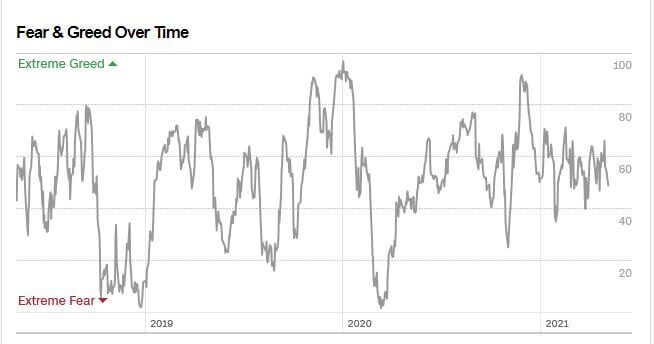
While it seems counterintuitive, there is a strong positive correlation between sentiment and stock prices. Sentiment rises as markets rise and fall when markets fall. This behavior is the exact opposite of the adage “buy low, sell high” and is the reason why many investors find it hard to succeed in the long-term trying to trade in and out of the market based on expectations. Our method of managing client portfolios relies entirely on a systematic process to keep portfolios balanced to their long-term objective and adjusts them when individual components get too large or too small. This strategy lends itself to buying low and selling high, which lines up with the extremes shown above in market sentiment. In December 2018 and March 2020, we were aggressively buying stocks for our clients, and in late 2020 we were actively trimming from stocks. Again this has nothing to do with our forecasting ability and everything to do with our unemotional, rules-based approach.
So while many investors are looking at adding stocks when flying high, eventually, all flights will come back to the ground. Rather than trying to time purchases and sales based on investors’ emotions or momentum, we prefer a measured approach to rebalancing that leads to selling high, and when prices come back down to Earth, buying low.
Nathan Smith is the Portfolio Manager with Rather & Kittrell.