Articles
Bear Spray and Behavior - What does Investing Risk Look Like to You?
09.12.2025
 Last summer, my husband, parents, sister, and I spent a week in Crested Butte, Colorado. It is a beautiful place I hope to return to…next time with bear spray.
Several of the hikes we went on were remote. Remote, meaning we didn’t pass a single car on the road while driving to the trailhead, nor did we pass anyone on the trail, and had no cell service. On one particular hike, we came across a large moose sleeping in a wooded grove right off the trail. Shortly afterwards, we saw a bear. Needless to say, it was hard for me to focus on anything but the wildlife on this hike, particularly when we later passed the moose again, but this time it was standing and staring right at us.
We made it back to a quaint coffee shop without incident, where I proceeded to Google what to do if you encounter an aggressive moose (Run. This isn’t a play dead situation. It’s a if-they-can-see-you,-they-may-be-annoyed-by-you-and-want-to-stomp-you situation). My main takeaway was to buy bear spray and bring it with me on future hikes in the Colorado wilderness. Sure, the risk of a moose or bear attack was slim but it was not something that I wanted to worry about.
My sister, who lives in Colorado, did not share my concern. The chance of a moose or bear attack is so low that it’s not a risk she sees worth protecting against. I left my bear spray with her anyway.
We all think about and handle risk differently, and I’ve been thinking the topic or risk as it pertains to investing.
When you hear the word risk in the context of investing, what do you think of? Is it the risk of losing your money? The risk of not being able to achieve your goals? The risk of seeing your balance go down in the short term?
Let’s start with an extreme version of risk: losing all your money and being unable to achieve your goals. An example of being exposed to this sort of risk is gambling. Another is investing in one single company or entity. In these scenarios, losing all your money is a realistic risk to consider.
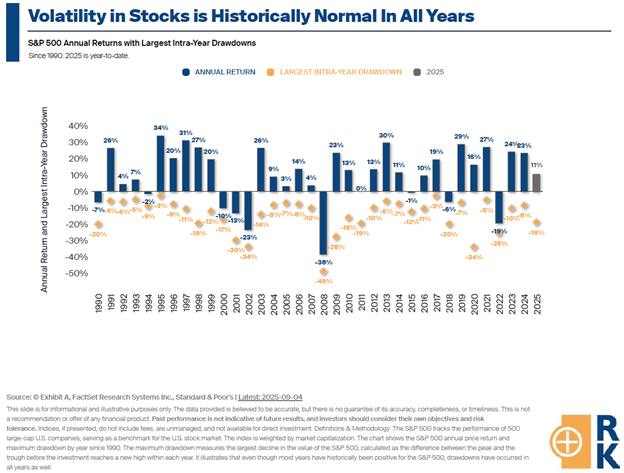
There is a another version of risk where your balance decreases in the short term. This exists anytime you invest, due to the ever-present risk-reward relationship. However, it is noteworthy that this risk differs significantly from the risk of losing all your money. It is normal, and even expected, for a 100% stock portfolio to drop in value at some point every year. The image below shows the S&P 500 since 1990. The yellow represents the most significant drawdown each year, and the navy bar represents where the year actually ended. As you can see, volatility is normal and is not indicative of the year’s outcome.
How much risk you take on is personal and shouldn’t be determined through completing a questionnaire. It depends on your goals, comfort level with volatility, and what’s important to you. I have seen many people invest both too aggressively and too conservatively for their personal goals because of miscommunications regarding the concept of risk.
When we discuss risk, we’re not suggesting that investors leave the proverbial bear spray behind. For critical assets (the irreplaceable money, the money that allows you to live the life you want), specific measures like diversification should be in place to protect from the worst type of risk. And then the level of volatility/growth potential your critical assets are exposed to should be personalized.
For our clients, we strive to ensure your investment strategy is the best possible approach for you. We’re here to help if this is a topic you want to discuss.

Hannah Whatley, CFP® , AIF® is an advisor with Rather & Kittrell.