Articles
Why Market Volatility Isn’t a Reason to Panic
08.09.2024
I’m sure you saw the headlines.
After hitting new highs last month, markets dropped dramatically, erasing months of gains.1
It feels like the sky is falling.
Let’s take a step back and take a look at what’s going on. (Scroll to the end if you want our takeaways.)
What’s behind the market drop?
A couple of major factors fueled the sudden selloff:
1. Weaker-than-expected economic data that sparked recession fears.
July’s soft jobs report triggered a recession indicator that caused U.S. stocks to sell off in fear.2
Though it does not appear that the U.S. is in a recession now, weakening economic data is increasing the risk that a recession will strike.
2. Speculative currency trading by corporate investors.
“Carry trading” is a risky strategy that involves borrowing money in a currency with a low interest rate (such as the Japanese yen) and then reinvesting the money somewhere else where returns are higher.3
This strategy has become popular in recent years because of Japan’s very low interest rates.
Its success depends on cheap borrowing currencies and low market volatility.
However, that strategy is no longer paying off.
Japan’s central bank recently hiked interest rates, and markets grew more volatile, hitting traders with a double whammy.
The “unwinding” of these speculative investments triggered a global selloff as traders sold positions to cover losses.
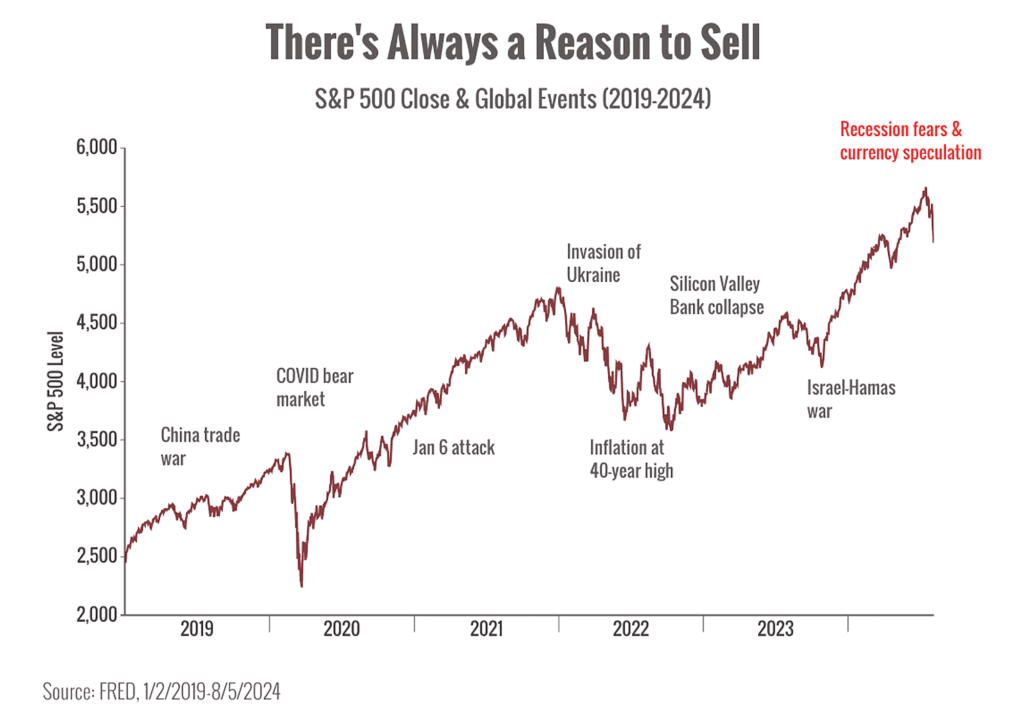
Hard investing truth: there’s always a reason to sell.
Markets are always waiting for the next opportunity to melt down.
That’s part and parcel of being an investor these days.
There will always be something happening that can cause anxiety, fear, and the knee-jerk desire to sell.
But panic selling in response to a market stumble is the wrong move.
|