Articles
Why Investments Are More Than Just a Banana Taped to a Wall
03.14.2025
In the world of art, headlines are often made by the unusual and the absurd. A recent example is the now-infamous banana taped to a wall, titled Comedian, which sold for a staggering $6.2 million at auction.
While the piece sparked debates over artistic merit, it also served as a fascinating illustration of a fundamental principle: assets are worth whatever someone is willing to pay for them.
This concept applies not just to the art world, but also most things for sale from real estate to everyday consumer goods.
A banana taped to a wall may sound like a joke, but it managed to command a seven-figure price because someone—or more accurately, several collectors—believed it was worth that much. Whether the buyers were drawn to the work’s conceptual nature, its commentary on consumerism, or its novelty, the key takeaway is clear: value can be subjective.
In financial markets, it can feel like investments such as stocks and bonds are priced the same way. Assets can fluctuate up and down intraday for hard to describe reasons other than the feelings of other market participants. In the short term, these investments can appear to mimic the art market, where the prices are only based on what someone else is willing to pay.
Fortunately, stocks and bonds are not purely valued this way because, unlike art, something tangible backs up their price values.
Stocks represent real ownership in well-known companies, often with enormous positive cash flow. When investors own stocks, they hold the rights to receive their portion of these profits and the share appreciation that comes with them. For bonds, the same goes for their promised interest payments.
In the long-term, stock prices have not been valued on taste, perception, or headlines but have very closely tracked their real company earnings.
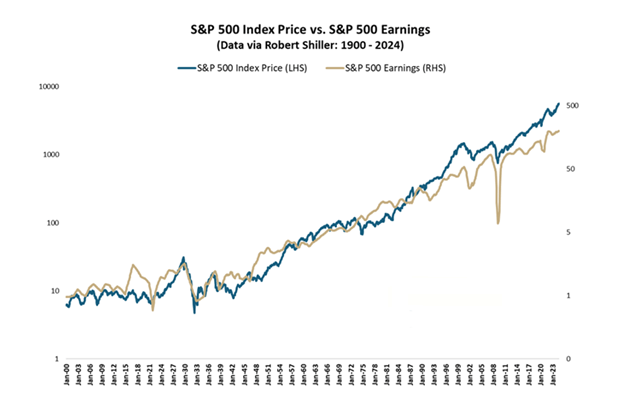
It could be argued that a banana taped to a wall has little value; it is harder to argue a company producing billions of dollars in profits is similar.
Having a tailored plan that involves owning these backstopped investments in the correct proportions to match individual financial goals, timelines, and risk capacity is key to long-term investing success and seeing beyond the market noise of today.
Besides, it is nice to not have to worry about someone eating your very valuable artwork.
Chase Kerby, CFP®, AIF® is a Senior Advisor with Rather & Kittrell.