Articles
Is Now a Bad Time to Invest?
07.28.2025
I bought my first home in the summer of 2016. For those of you who weren’t home shopping then, the real estate market was hot. Home values had been rising for years and were at an all-time high where I live. It felt like the worst time to be a buyer. More than one person told me to wait for things to cool off, but I needed a place to live.
The home I ended up buying lasted exactly one day on the market with multiple other competing offers. It didn’t feel terribly lucky to have my offer accepted, as I won the right to pay what felt like a lot of money to fork over at the very top of the real estate market.
Nine years later, that house is worth far more than what I paid. It was an all-time high for home values, but it was far from the top.
The same thing has happened in the investment markets and continues today.
“Is Now a Bad Time to Invest?”
This is one of the most common questions we hear, especially when markets are hitting all-time highs. The S&P 500 is setting records, the Nasdaq is climbing, and headlines are filled with terms like “overvalued” and “frothy.” It can feel uncomfortable to invest when prices are high, like you’re walking into a room just as the party is about to end. This is exactly how I felt buying my home. But history, and my personal experience, tell a different story.
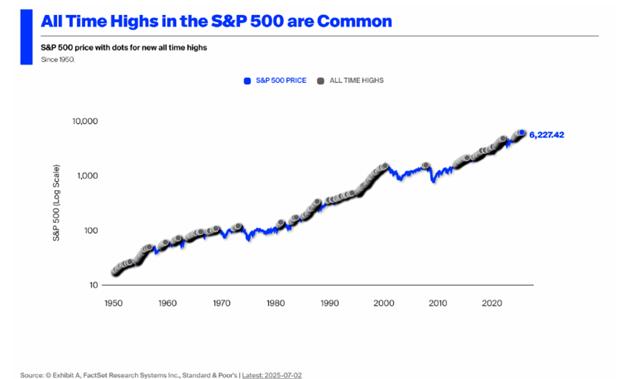
Market highs are more common than most of us think. They are, in fact, a natural part of long-term growth. Since 1950, the S&P 500 has hit an all-time high in over 1,100 different weeks. That’s about one out of every seven weeks. In other words, markets are often at all-time highs because over time, they tend to go up.
According to research from FactSet:
- After hitting a new all-time high, the S&P 500 has averaged a 1-year return of +9.4%
- Over 3 years, the average cumulative return is +29.1%
- Over 5 years, it climbs to +50.2%
Investors surprisingly earned more, on average, investing at new market highs versus all other days.
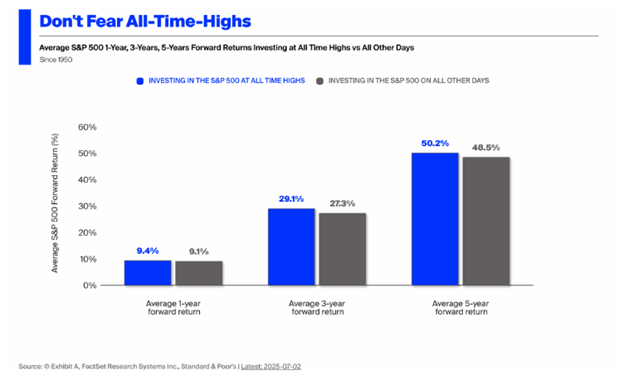
There’s nothing magical about market highs that predict tops or future losses. More often than not, new highs are followed by more new highs.
Long-Term Investing Is What Matters
Trying to wait for the perfect entry point often leads to missed opportunities. Investors who sit on cash waiting for a dip rarely feel good jumping in when markets are falling, and they end up missing growth along the way.
It’s better to invest steadily and stay invested. Time in the market, not timing the market, is what drives results. And for most of our clients, the goal isn’t to maximize returns in a given quarter, it’s to grow wealth in a way that supports their lives for decades.
When I think back to my home purchase nearly a decade ago, what made it a good decision wasn’t the price on the day I bought it. It’s the years I have been living in it, the appreciation that came with time and patience, and the confidence that came from moving forward instead of standing still.
The same is true for investing. All-time highs aren’t something to fear. They’re a sign of progress.
If your goals are long-term, and your plan is sound, today is still a good day to invest.
Chase Kerby, CFP®, AIF® is a Senior Advisor with Rather & Kittrell.