Articles
What Baseball Taught Me About Investing: Why Process Beats Prediction
05.30.2025

Baseball fans out there may not believe this, but I did not know what the term “force-out” meant until I was 41 years old. It’s true. I finished my last year of baseball when I was 11 years old and never really grasped the game. Since then, I can count on one hand how many baseball games I have watched in person over the next thirty years.
My oldest son, AJ, started his first year of recreational baseball at age 5 and life hasn’t been the same since. I still remember driving him to our first practice and from the backseat AJ said, “Daddy, I don’t want to do this.” I’m glad I didn’t listen to him. Eight years later, he’s still playing and now his baby brother, Ethan, has started his baseball journey, too.
I played football for a long time, and as a result, it’s woven into my life, yet baseball has a mystique that I find hard to describe. To say I now have an appreciation for the game would be an understatement. One thing I know about baseball is that everything is measured.
I watched the movie Moneyball recently which tells the story of how Billy Beane changed baseball. He stopped listening to the old-school scouts who said things like, “The kid just looks like a ballplayer.” Instead, he trusted the data. On-base percentage mattered more than jawlines, batting stances or how pretty the player’s girlfriend was. He built a competitive team using numbers most people ignored.
This process was uncomfortable, especially for the veteran scouts. They thought he was ignoring their experience and common sense. But in the end, his approach worked because it was tied to evidence, not instincts or opinions.
There’s a lesson in that for investors.
Every time I watch that movie, I’m reminded of the similarities between traditional MLB scouts and Wall Street prognosticators like brokers, bankers, and analysts. No one knew that Billy Beane, a five-tool baseball player in high school, would end up being a bust in MLB. Similarly, no one knows what will happen in the capital markets, now, or in the near future.
Recently, a chart has made the rounds comparing what equity analysts forecasted for the S&P 500 at the beginning of 2024 versus how it actually performed. Most of the projections were well below reality. Analysts predicted modest gains—maybe 5% or 6% for the year. Some were even lower. The actual performance? More than double that by year-end. Looking at this chart reminds me of what the great philosopher Yogi Berra said about predicting, “It’s tough to make predictions, especially about the future.”
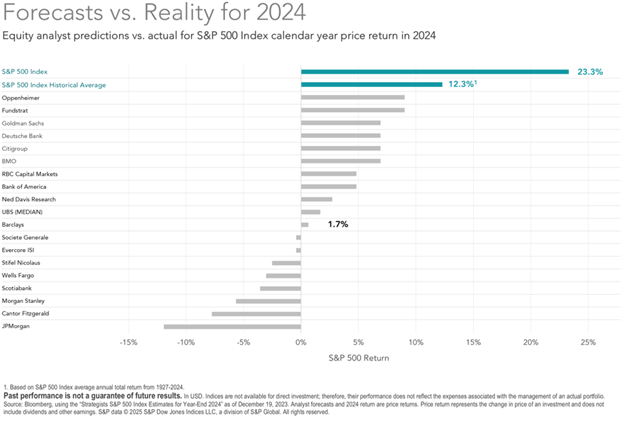
| So, what happened? And why does this matter?
The answer is in the numbers. Just like those baseball scouts, market analysts rely on a mix of expertise and intuition. They review earnings reports, study macroeconomic trends, and build models. But they still try to predict the future. Billy Beane figured it out. He wasn’t trying to guess who might have a breakout season. He was stacking the odds in his favor through data analytics. Investors should take the same approach. You don’t need to know where the stock market will go next. You need a plan that works no matter what happens. Because the truth is, most predictions—even well-informed ones—don’t pan out. This is why we believe in process over prediction. |
| At Rather & Kittrell, we build financial plans the way Beane built the A’s—with data, discipline, and a long-term view. We focus on what we can control: costs, taxes, allocation, and behavior. We don’t make bets based on what we think might happen. We build portfolios to help clients reach their goals regardless of the headlines.
The market, like baseball, rewards consistency over time—not instincts or hunches.
Jeff Hall, CFP® , CIMA®, CKA® is a Partner and Senior Advisor with Rather & Kittrell. |